Nigeria Rejects Trump’s Religious Freedom Designation Amid Diplomatic Tensions
Nigeria’s federal government has strongly objected to former U.S. President Donald Trump’s decision to redesignate the country as a “place of particular concern” over alleged violations of religious freedom, arguing that the accusations do not reflect the realities on the ground. The move could pave the way for potential U.S. sanctions, including the suspension of non-humanitarian aid, and has reignited debate over how complex security challenges in Africa’s most populous nation are often simplified into religious narratives that serve political ends.
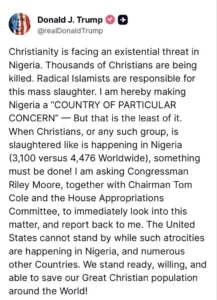
Trump, in a statement on Friday, said Nigeria posed an existential threat to Christianity, claiming thousands of Christians had been killed by “radical Islamists.” He tasked Congressman Riley Moore and Chairman Tom Cole of the House Appropriations Committee with investigating the situation. Moore’s October 6 letter to Secretary of State Marco Rubio alleged that over 7,000 Christians were killed in Nigeria in 2025 alone — figures that, if true, would amount to a grave humanitarian crisis.
However, Nigeria’s government has firmly rejected those assertions. Analysts also point out that while Christians have suffered attacks, most victims of armed violence are Muslims living in the country’s northern regions — challenging the U.S. narrative of systematic Christian persecution. Experts argue the violence stems from overlapping issues such as terrorism, banditry, ethnic rivalries, and resource competition rather than pure religious animosity.
In a statement issued by Kimiebi Imomotimi Ebienfa, spokesperson for the Ministry of Foreign Affairs, Nigeria emphasized that the country enjoys religious coexistence and remains committed to combating terrorism and promoting interfaith harmony under President Bola Ahmed Tinubu’s leadership. Yet critics say such claims ring hollow amid the ongoing insecurity fueled by Boko Haram insurgents, banditry in the northwest, and deadly farmer-herder clashes across the Middle Belt.
Nigeria was previously listed as a country of particular concern in 2020 under the U.S. International Religious Freedom Act, a designation later lifted by the Biden administration in 2023 to improve bilateral relations. Trump’s decision to reinstate the designation, this time explicitly citing Christian persecution, marks a significant shift in tone.

Observers note that Trump’s framing mirrors that of U.S. conservative lawmakers like Senator Ted Cruz and Congressman Moore, who have described Nigeria’s crisis as “Christian genocide” and urged sanctions against Nigerian officials. Yet independent reviews by PREMIUM TIMES and other human rights organizations dispute this characterization, asserting that while persecution exists, the broader violence cannot be reduced to religion alone. Instead, they cite root causes including weak governance, poverty, and environmental stress.
Nigeria’s complex religious demography — a Muslim-majority north and largely Christian south — has long coexisted with pockets of tension. Conflicts involving Fulani herders and Christian farmers, for instance, are often misrepresented as religious when they primarily concern access to land and water resources. Similarly, extremist groups like Boko Haram have targeted Muslims and Christians alike, attacking mosques, churches, and entire communities indiscriminately.
Under the 1998 Religious Freedom Act, Nigeria’s redesignation allows for diplomatic and economic sanctions, including restrictions on military aid. Such measures could complicate ongoing U.S.–Nigeria security cooperation, particularly in counterterrorism efforts. Nevertheless, Nigeria has pledged to engage the U.S. constructively to clarify misconceptions and reinforce its commitment to peace and stability.
The political motivations behind Trump’s move are also apparent. His position aligns with the interests of evangelical Christian advocacy groups in the U.S., who see Nigeria as emblematic of global Christian persecution. For Nigeria, however, the timing is problematic — coming amid economic turmoil, inflation, and a devalued currency that make strained U.S. relations a risky prospect.
Ultimately, the truth appears to lie between both narratives. Christians in Nigeria have endured horrific attacks that demand attention, yet Muslims have also borne immense suffering under the same cycles of violence. Reducing these tragedies to religious persecution risks obscuring the deeper socioeconomic and political roots of insecurity.

Both governments face criticism for their responses — Washington for politicizing tragedy, and Abuja for downplaying the scale of the crisis. Analysts argue that genuine progress depends on addressing governance failures, boosting economic opportunity, and investing in environmental solutions to ease resource-based tensions.
For now, Nigeria plans to continue diplomatic engagement to contest Trump’s designation and avert sanctions. But while officials debate semantics abroad, ordinary Nigerians — Christian and Muslim alike — remain caught in the violence, awaiting tangible action from both their leaders and the international community.